New technology aims to improve communications for future space travel
A Cardiff Metropolitan University researcher has developed a lightweight, high frequency smart flat-panel antenna for small satellite platforms like CubeSats. The proposed antenna is designed to enhance satellite communications performance while reducing antenna mass and costs to support more reliable and cost-effective space missions.
CubeSats are increasingly used for space missions; however, their size, mass and power constraints present significant challenges for maintaining reliable satellite-to-ground communication links. Conventional antennas can be bulky, heavy, or power-intensive, while mechanically steered alternatives increase system complexity, cost and potential failure risk.
Dr Jasim Uddin from Cardiff School of Technologies has developed a new antenna specifically designed for small satellite communication applications and experimentally validated at the Satellite Applications Catapult.
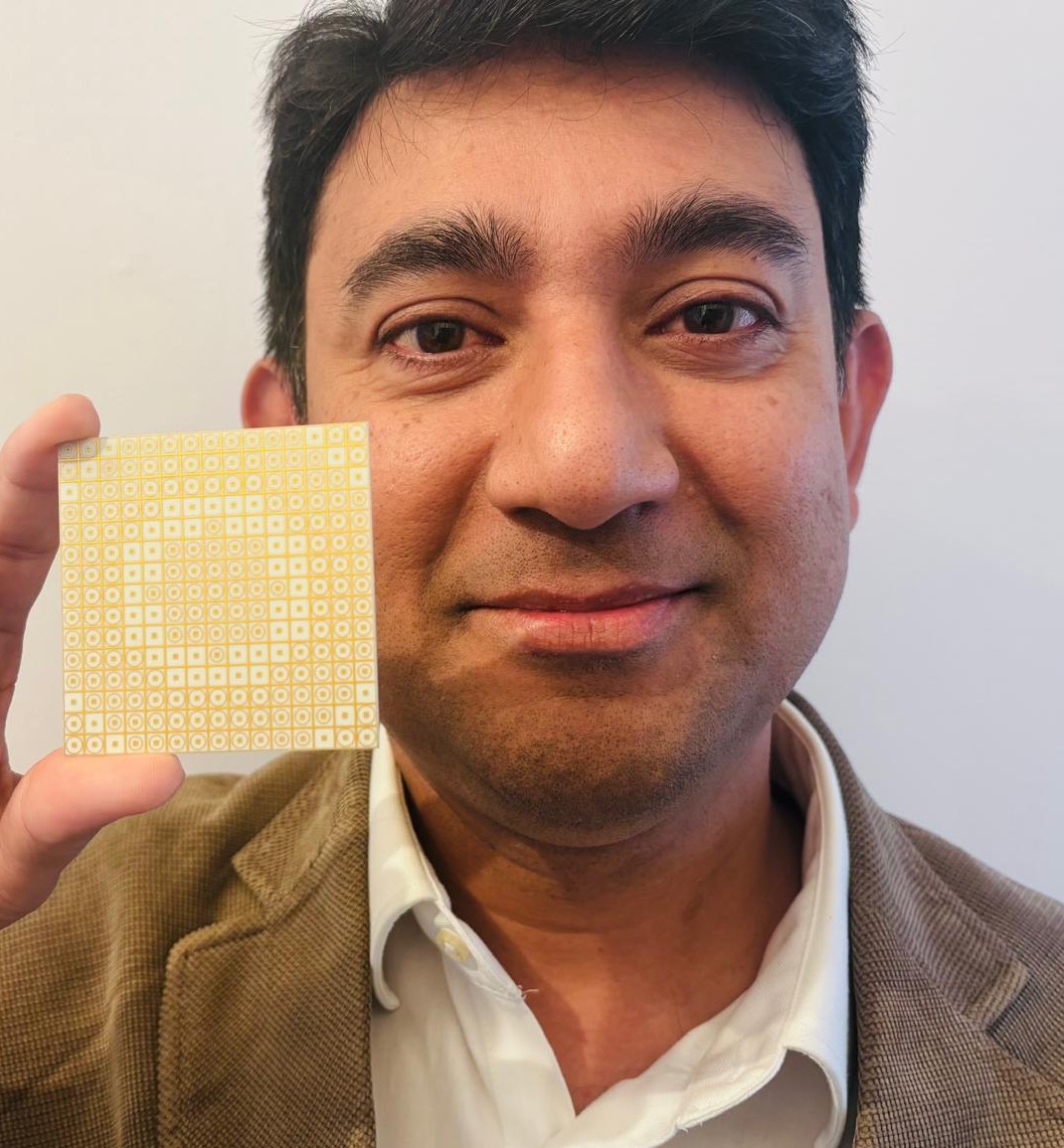
Dr Uddin's antenna uses specially engineered materials and structures to control radio signals without the need for bulky moving parts. The result is a flat, compact design that is significantly lighter and simpler than many conventional satellite antenna systems.
Despite its reduced size, the antenna is capable of delivering the high levels of performance required for satellite communications that making it suitable for CubeSat missions where every gram and centimetre matters.
Dr Uddin said:
"As small satellites become increasingly important for communications, Earth observation and scientific research, there is a growing need for antenna technologies that can deliver high performance within very limited space and weight constraints.
"Our aim was to develop a solution that combines simplicity with efficiency. By removing the need for complex mechanical systems, we can reduce both weight and potential points of failure while maintaining strong communication performance."
A prototype antenna was developed and tested at the Satellite Applications Catapult, a leading UK innovation centre for the space sector.
The successful results confirmed that the compact design can meet the demanding performance requirements of satellite communications while remaining suitable for the strict size and weight limitations of CubeSats.
The research shows that small satellites can achieve reliable, high-quality communications without the need for more complex and heavier antenna systems.
As CubeSats continue to be adopted for commercial, scientific and government missions, the technology could help support more efficient and cost-effective satellite operations in the future.
The project also helped strengthen collaboration between Cardiff Metropolitan University, the Satellite Applications Catapult and industry partners.
These partnerships are helping to create new opportunities for future research, funding and potential commercial applications of the technology.
Dr Uddin said:
"Collaboration is vital to advancing space technologies. Working closely with partners across academia and industry has enabled us to share knowledge, validate our research and identify opportunities for future innovation and impact."