MISLToe_SSD
1. Overview
Why MISLToe_SSD?
Children with speech sound disorder (SSD) have difficulties producing the sounds of speech clearly, which can make them difficult to understand. Some children have a clear underlying cause, such as cleft palate, cerebral palsy, or hearing loss. However, most cases have no known cause. SSD is relatively common, affecting around 3–4% of children aged 4–8. If it is not treated early, it can have long-term effects on education, employment and mental health.
Early intervention can improve children’s quality of life. However, most evidence for speech and language therapy comes from research studies, not from everyday clinical practice. In real-world settings speech and language therapy services for children with SSD vary across the UK and are limited by available resources. This variability makes it difficult to collect large‑scale clinical data and to identify which approaches are most effective for children outside controlled research environments.
How will MISLToe_SSD help?
The MISLToe_SSD (Maximising the Impact of Speech and Language Therapy for children with Speech Sound Disorder) project aims to establish a standardised process to collect routine clinical data before and after speech and language therapy for children with SSD.
By using a shared system, we can combine information from multiple NHS services. This will allow statistical analyses to be undertaken, helping to identify which interventions are most effective for children with different types of SSD in real world clinical settings.
2. Meet The Team
Professor Yvonne Wren, BSc(Manch)(Hons), MEd(Bristol), PhD(Bristol), FRCSLT, FLSW
Professor of Speech and Communication, University of Bristol
Professor of Speech and Language Therapy, Cardiff Metropolitan University
I am Director of Bristol Speech and Language Therapy Research Unit (BSLTRU) and initiated the MISLToe study. In 2005, I qualified as a speech and language therapist at the University of Manchester. I then worked clinically in Liverpool and Bristol for ten years before embarking on my PhD which was awarded in 2005 from the University of Bristol. I was successful in my application for an NIHR Postdoctoral Fellowship in 2011 and more recently, was elected Fellow of the Royal College of Speech and Language Therapists (2022) and Fellow of the Learned Society of Wales (2026).
I am a senior research advisor to the Royal College of Speech and Language Therapists (RCSLT), a member of the International Expert Panel on Multilingual Children’s Speech and a consultant to the Child Speech Committee for the International Association of Communication Sciences and Disorders. The impact of my work beyond MISLToe includes the development of two sets of guidelines for the transcription and analysis of children’s speech with the Child Speech Disorder Research Network and the identification of risk factors for persistent speech disorders.
My awards include a Giving Voice award from the RCSLT in 2022, Certificate of Appreciation from the International Association of Communication Sciences and Disorders in 2021, the Patient Involvement and Engagement in Research (PIER) Award from the Royal College of Paediatrics and Child Health (with colleagues in the Cleft Collective) in 2020, and the Editor’s award for the Speech Section of the Journal of Speech, Language and Hearing Research (with Sound Start Study colleagues) in 2017.
Current research
My research focuses on speech sound disorder and cleft lip and palate, and I lead multidisciplinary research across speech, language, communication, and swallowing disorders.
Current and recent research projects include:
- MISLToe_SSD study (Chief Investigator)
- Prosiect Pengwin (Chief Investigator)
- Cleft@18-23 study (National Institute of Health Research Programme Grant leader)
- The Cleft Collective Cohort Studies (Chief investigator)
Linked profiles of academic outputs
ORCiD – Yvonne Wren (0000-0002-1575-453X) - ORCID
Researchgate – https://www.researchgate.net/profile/Yvonne_Wren
Dr Sam Burr, BA, MSc, PhD
Research Fellow
I am a qualified Speech and Language Therapist with almost 10 years clinical experience. Funded by a National Institute for Health and Care Research (NIHR) Clinical Doctoral Research Fellowship, I completed my PhD in 2022. Within the BSLTRU team I have worked in a variety of roles including as Senior Research Associate coordinating the NIHR RfPB funded MISLToeSSD (Phase 1) study and facilitating the SSLiC study (University of Bristol). I currently lead Phase 2 of the MISLToe_SSD study in England (NIHR RfPB Tier 2) and Wales (HCRW IFS). I am also leading the PROSPER study, which is funded by a Health and Care Research Wales Advanced Fellowship and aims to improve speech outcomes for preterm-born children in Wales.
I am a passionate advocate of clinical academic roles through my work as a Research Champion for the Royal College of Speech and Language Therapists (RCSLT) and former role as Clinical Academic Lead for Solent NHS Trust. I am a Clinical Academic mentor through the RCSLT offering support to clinical colleagues looking to explore the clinical academic career pathway.
Current research
Current and recent research projects include:
MISLToe_SSD Phase 2 England study (Chief Investigator)
MISLToe_SSD Phase 2 Wales study (Chief Investigator)
PROSPER (Chief Investigator)
Linked profiles of academic outputs
Orcid ID - ORCiD
Senior Research Fellow
I am a Health Psychologist with qualifications in research methods, medical education, implementation science and leadership. Over the last twenty years I have conducted research with, and on behalf of the NHS, charities, and commercial research organisations. I currently work in Research and Development and at the Bristol Speech and Language Therapy Research Unit, where I have my own portfolio of research and support the development and delivery of speech and language therapy focused research.
My research focuses on the impact of disease and treatment on the biological, psychological and social aspects of patients’ outcomes, with particular expertise in research methods. I have worked across primary and secondary health care settings in diverse fields including breast cancer, chronic respiratory disease, hyperbaric medicine, maxillofacial cancer, speech and language therapy and stroke. I lead the SNAHPer (Scientist, Nurses and allied health professional early researchers) group. I am a CAHPR Connector, working with multiple universities and hospitals to support AHP developed and lead research, and a member of CARIN (Healthcare Professionals Clinical Academic Roles and Career Pathways Implementation Network).
Current research
My research interests include
- Parental understanding of speech and language impairment in their preschool children
- Positive psychological change
Current and recent research projects include:
- MISLToe_SSD study
- Prosiect Pengwin
Linked profiles of academic outputs
- ORCiD - 0000-0002-5870-2094
- LinkedIn - Sam Harding | LinkedIn
- Research Gate - researchgate.net/profile/Sam_Harding
- Web of Science ( ResearcherID J-2952-2019) - https://publons.com/author/1478640/
Prof Joanne Cleland, BSc(hons), PhD
Professor of Speech and Language Therapy
I am a Professor of Speech and Language Therapy in the Department of Psychological Sciences and Health at the University of Strathclyde in Glasgow. My expertise is in developmental Speech Sound Disorders with an emphasis on innovative assessment and intervention tools. My work spans theoretical research using instrumental articulatory approaches to applied clinical research working with practitioners. I joined the University of Strathclyde in 2015 having previously worked at Queen Margaret University where I completed my PhD in 2010 and my clinical qualification as a Speech and Language Therapist in 2002.
I am the vice president of the International Clinical Linguistics and Phonetics Association; the UK representative on the Child Speech committee for the International Association of Communication Sciences and Disorders; a member of the UK and Ireland Child Speech Research Network; and a panel member for Unit of Assessment 3 (Allied Health Professions, Dentistry, Nursing and Pharmacy) for the Research Excellence Framework, 2029.
Current Research
Current and recent research projects include:
Speech Therapy Animation and Imaging Resources
Linked profiles of academic outputs
ORCiD – 0000-0002-0660-1646
LinkedIn –
Research Gate –
Dr Caitlin Holme BA, MA, PhD
Senior Research Associate
I completed my BA in Spanish and Linguistics at the University of Southampton in 2016, and then pursued my interest in both acquired and developmental language disorders through an MA in Clinical Linguistics from the University of Amsterdam. As part of my Master’s degree I also completed an internship at the Speech and Language Therapy Department of the Pontificia Universidad Católica in Santiago, Chile. In 2019 I joined BSLTRU as a Research Associate, using qualitative methods to evaluate the acceptability of a new tool for assessing children’s speech and language needs.
Between 2020 and 2024 I completed my PhD at the University of Bristol, in collaboration with BSLTRU. The aim of my PhD was to inform the theoretical background of parent-child interaction interventions, by exploring how variation in children’s everyday activities leads to different types of interaction. My findings informed recommendations for speech and language therapists, including working with individual families to understand their meaningful opportunities for interaction, and the potential for using creative methods in clinical practice. My PhD thesis was nominated for the University of Bristol’s Doctoral Dissertation Prize.
Current research
I am currently working on the NIHR-funded MISLToe-SSD project. My role involves supporting NHS sites to collect routine clinical data using the MISLToe_SSD protocol, and conducting qualitative research including focus groups and interviews.
My research interests include:
- Speech and language development and wellbeing in multilingual children
- Lived experience of speech and language disorders in children and adults
- Cultural validity and acceptability of speech and language therapy assessment and intervention
- Use of qualitative and creative methods in research and clinical practice
Linked profiles of academic outputs
ORCiD - Caitlin Holme (0000-0003-4214-112X) - ORCID
LinkedIn - Caitlin Holme | LinkedIn
Research Gate - https://www.researchgate.net/profile/Caitlin_Holme
Dr Paola Calabrese
BA, MSc, PhD
Postdoctoral Research Fellow
I am Speech and Language Therapist qualified at the University of Rome Tor Vergata (Italy) in 2015. I worked for three years as a Speech and Language Therapist within services funded by the Italian National Health System in Rome, specialising in the assessment and support of children with speech and language difficulties.
In 2020, I completed an MSc in Developmental Linguistics at the University of Edinburgh. In 2021, I was awarded full funding to undertake a PhD in Clinical Sciences at the University of Reading. My doctoral research investigated the mechanisms underlying word learning difficulties in children with Developmental Language Disorder and strategies to support vocabulary acquisition in this population. Informed by my clinical experience in settings where practice was often constrained by limited research evidence, my primary research interest lies in bridging the gap between empirical research and clinical practice to improve assessment and intervention for children with speech and language needs.
Current Research
Project coordinator for MILSToe SSD 2 Wales, funded by Health and Care Research Wales.
My research interests include:
- Evidence-based interventions for children with speech sound disorders
- Evidence-based interventions for children with developmental language disorder
- Care pathways for children with speech, language, and communication needs
Linked profiles of academic outputs
ORCiD – 0000-0002-8627-5982
LinkedIn – Paola Calabrese | LinkedIn
Dr Reny Raju
BSc, MSc (SLP), PhD
Senior Research Associate
I completed my bachelor’s degree in Speech-Language Pathology and Audiology in 2017 from the Dr S.R. Chandrashekar Institute of Speech and Hearing, Bangalore, India, where I secured third rank at Bangalore University. I then pursued a Master’s degree (2019) in Speech-Language Pathology at the All-India Institute of Speech and Hearing, Mysore, India, graduating as a Gold Medallist and Best Clinician. Following this, I worked for one year (2019-2020) as a Speech-Language Pathologist (Grade-1) in the Department of Clinical Services at the institute, where I gained valuable clinical and research experience.
Motivated by an interest in bridging the gap between clinical practice and research—particularly in the early identification and intervention of developmental communication conditions—I enrolled for a PhD in Speech Pathology and Audiology at the National Institute of Mental Health and Neurosciences (NIMHANS), Bangalore, India. My doctoral research examined maternal linguistic and gesture input in mothers with severe postpartum mental illness and its impact on infant development. I was awarded my PhD in November 2025. Alongside my doctoral work, I was part of The Infant–Toddler Language Development and Intervention Lab (LiL’), where I contributed to conducting a feasibility randomized controlled trial of a caregiver-mediated early support program (LiL’ STEPS) delivered online for infants at elevated likelihood for autism.
Current Research
I am currently a Senior Research Associate at the Bristol Speech and Language Therapy Research Unit. My work focuses on supporting Phase 2 of the MISLToe study, including the development of a questionnaire to collect routine clinical data for children with speech sound disorders (SSD) and exploring the facilitators and barriers to implementing routine data collection within the NHS.
Linked profiles of academic outputs
Orcid ID – 0000-0003-1905-4845
LinkedIn –
3. Information For Families
MISLToe_SSD is a research project aiming to improve how Speech and Language Therapists (SLTs) collect and use information when working with children who have speech sound disorder (SSD).
Children with SSD find it hard to say certain sounds clearly, which can make their speech difficult for others to understand.
What is the aim of the project?
We want to develop a standardised form to help SLTs record important information consistently during routine therapy sessions.
By improving how this information is recorded, we aim to:
- Understand what works best for children with different types of SSD.
- Understand which interventions are most cost-effective.
- Track children’s progress more clearly.
- Support high-quality care across the NHS.
MISLToe_SSD is a three-phase project. Here is a video explaining the MISLToe Study
(video link to be inserted)
How can you get involved?
There are two ways you can take part in MISLToe_SSD_UK:
- Your child may be able to join Phase 2 or Phase 3 of MISLToe_SSD if they are receiving speech and language therapy at one of the participating NHS services.
- You can share your views. Parents’ perspectives are essential to ensure that families’ experiences and priorities shape the research.
If you would like to be involved or know more about MISLToe_SSD get in touch with the team at misltoe@nbt.nhs.uk
4. Information For Professionals
MISLToe_SSD is a research project aiming to improve how Speech and Language Therapists (SLTs) collect and use information when working with children who have speech sound disorder (SSD). It is a three-phase project:
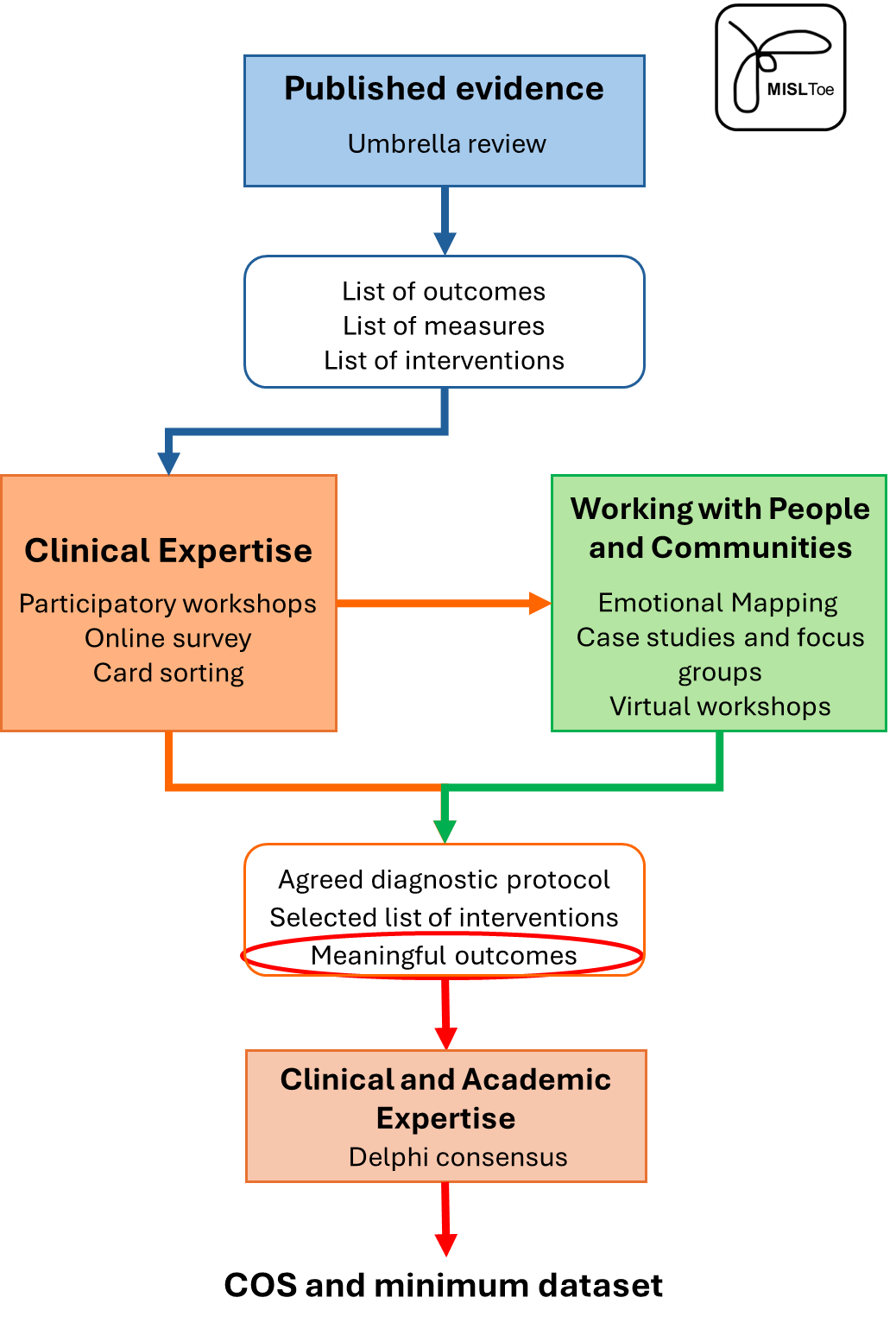
- Phase one led to the development of an agreed set of assessments for Speech and Language Therapists to diagnose SSD, an agreed list of speech and language therapy interventions that SLTs might use, and a Core Outcome Set (COS). A COS is agreed, standardised list of outcomes to be measured before and after therapy.
- Phase two is a feasibility study that explores the barriers and enablers to the collection of data on the MISLToe_SSD COS within speech and language therapy services across the UK.
- Phase 3 will roll out the protocol at scale. This will enable the collection of large-scale data that can be used to explore the effectiveness and efficiency of interventions.
A methodology to develop your own MISLToe Core Outcome Set for use in other countries or with other clinical populations
The MISLToe team has worked with specialist Speech and Language Therapists (SLTs) to develop a core outcome set (COS) for children with speech sound disorder (SSD). A COS is a concise group of agreed measures for baseline and outcome data. The MISLToe SSD COS is designed for clinicians working with this group in the UK healthcare system.
If you live outside the UK, or work with a different client group, we have also developed the MISLToe Methodology. This provides guidance to help you create your own COS. Identifying a COS for each health condition supports:
- Consistency and systematic approaches to routine data collection in healthcare services
- Comparability of results across clinical trials
The COMET initiative supports researchers and healthcare professionals interested in collecting COS. A tutorial on COS is available on the COMET website.
Full details of the MISLToe methodology are available in the manual The MISLToe Methodology For developing a Core Outcome Set and Diagnostic Pathway in Speech and Language Therapy (LINK TO THE MANUAL HERE)
A how to Guide: MISLToe_SSD_UK
Seven NHS Health Boards in Wales and five NHS Trusts in England are currently taking part in the MISLToe_SSD study (Phase 2). This phase is exploring whether it is feasible to collect the core outcome set (COS) for children with speech sound disorder (SSD) as part of routine care in real-world healthcare settings.
If your site is not currently involved but you are interested in taking part in Phase 3, please click here.
If you would like to find out more about MISLToe_SSD_UK, or if you are a Speech and Language Therapist participating in the research project, you can access practical guidance in the:
MISLTOE_SSD MANUAL: Maximising the Impact of Speech and Language Therapy for Children with Speech Sound Disorder (LINK TO THE MANUAL HERE).
The manual provides practical guidance on:
- Following the diagnostic protocol
- Using standardised intervention definitions and labels
- Collecting data based on the agreed COS
For specific instruction on implementing the diagnostic protocol you can also watch this video (28) Minimum Diagnostic Protocol - YouTube